
How to Calculate Air Conditioner Capacity (BTU) Based on Home Size?
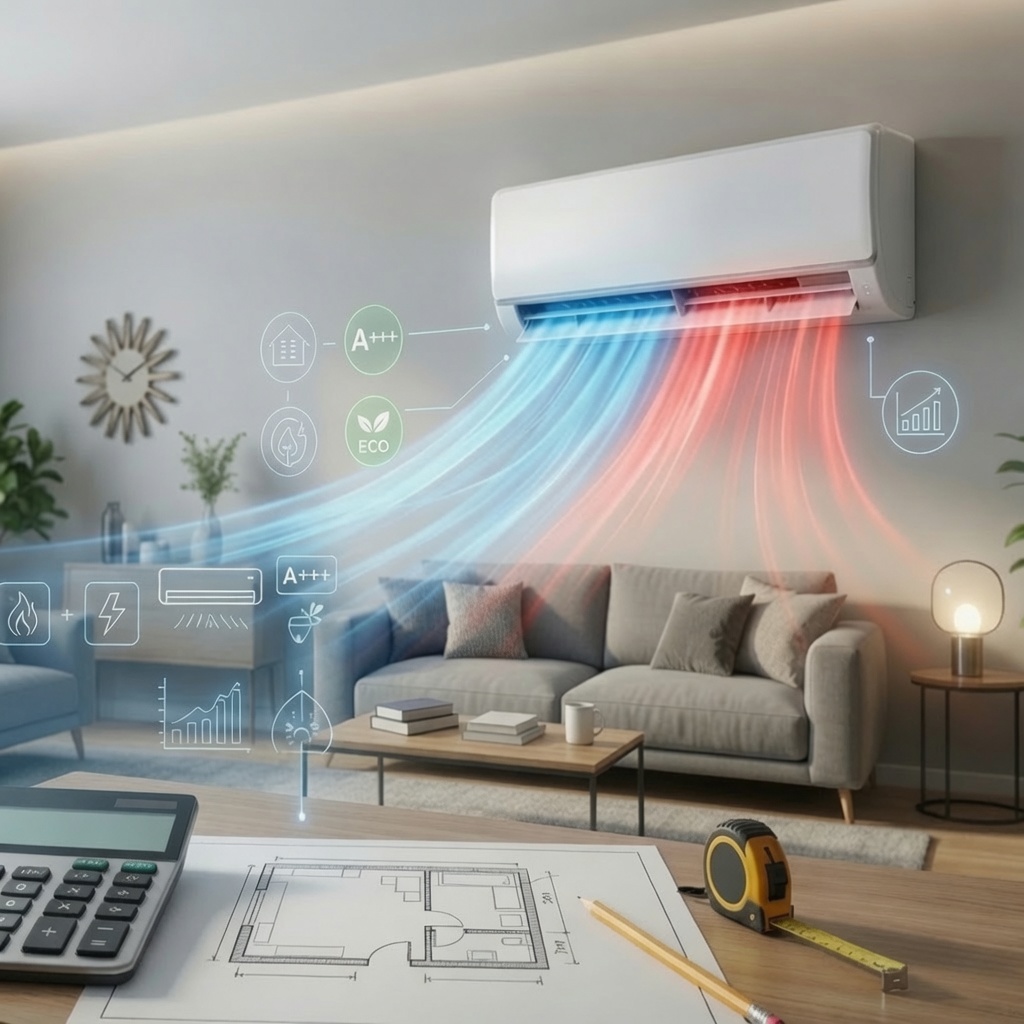
When buying an air conditioner for your home, one of the main issues customers face and struggle to decide on is choosing the correct capacity of the device. Selecting an air conditioner with the wrong capacity can lead to both inadequate cooling of your home and a waste of electricity. So, how should you determine the suitable model based on the square footage of your house or apartment?
In this article, we will explain in detail what air conditioner capacity (BTU) is and how to calculate it correctly for your home's area.
What is BTU and Why Should It Be Calculated Correctly for a Home?
BTU (British Thermal Unit) is an international unit of measurement representing the amount of heat an air conditioner can remove from a space in one hour, i.e., its cooling power. In Azerbaijan, models with capacities of 9000, 12000, 18000, and 24000 BTU are most commonly found for residential properties. Correct calculation is essential so that the device operates in an optimized manner perfectly suited to the volume of your home. If you are on a tight budget and looking for solutions for relatively small areas in your house, with proper BTU calculation, you can find affordable options that fully meet your needs among Split air conditioner on/off models.
Consequences of Choosing a Weak or Too Powerful Air Conditioner
If you buy an air conditioner that is too weak for your home's square footage, the device will run constantly at maximum power to cool the space. This will cause the motor to wear out quickly and significantly increase your electricity bill. Conversely, choosing an air conditioner that is overly powerful for a home space (e.g., 18000 BTU for 15 square meters) is also incorrect. A powerful device will cool the air too quickly and shut off without fully removing the humidity, creating discomfort.
The Impact of Home Layout, Ceiling Height, and Other Factors
Besides calculating square meters, whether your home receives direct sunlight, the ceiling height (standard 2.7 - 3 meters), and how many people are regularly in the space also play a major role. For south-facing and sunny apartments, it is recommended to add an extra 10-15% to the calculated capacity. Under such variable conditions, devices with Split inverter air conditioner technology are the best choice to keep your home's temperature constantly stable and maximize energy savings.
Table: Air Conditioner Capacity Based on Home Area
| Home/Space Area (sq.m) | Required Capacity (BTU) | Device Kilowatts (kW) |
| 10 - 15 sq.m | 9,000 BTU | 2.5 kW |
| 20 - 30 sq.m | 12,000 BTU | 3.5 kW |
| 35 - 45 sq.m | 18,000 BTU | 5.0 kW |
| 50 - 70 sq.m | 24,000 BTU | 7.0 kW |
Frequently Asked Questions (FAQ)
1. What capacity air conditioner should I buy for a 30 square meter home area (or living room)?
For a 30 square meter space with standard ceiling height, a 12000 BTU air conditioner is the most ideal choice. If your home receives a lot of sunlight, an 18000 BTU model can also be considered as a precaution.
2. Is the BTU calculation different for Inverter air conditioners?
No, the BTU calculation based on area is the same for both Inverter and On/Off air conditioners. The only difference is how and with what efficiency the device consumes this power.
3. How does ceiling height affect the calculation?
The table above is designed for standard (2.7 - 3 meters) ceilings. If the ceiling of your home is 3.5 - 4 meters, the volume of the space increases, so you must choose a device one step more powerful (e.g., 18000 BTU instead of 12000).
Conclusion
When choosing an air conditioner for your home, the BTU (cooling capacity) indicator is the most crucial detail. A correctly chosen capacity ensures that your space reaches the ideal temperature in a short time and minimizes your energy costs. Once you measure the square footage of your home and determine the power you need from the table above, you can visit our Cooling systems catalog to explore the highest quality models.